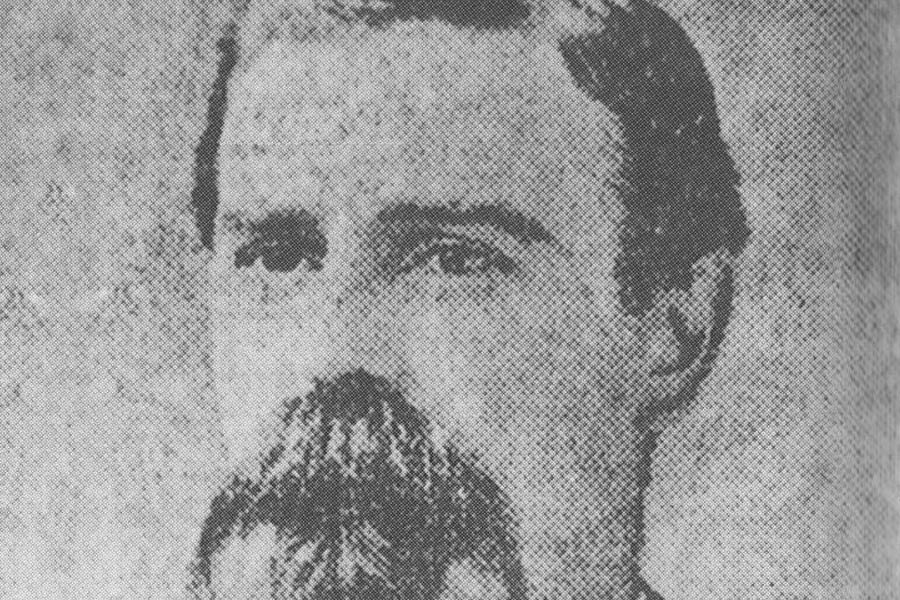
A son of the Surratt family
When I look at Isaac Surratt, I see a man standing at the edge of one of the most infamous family stories in American history, yet never fully swallowed by its shadow. He was born in early June 1841 in Prince George’s County, Maryland, and he lived until November 1907, reaching the age of 66. He was the eldest child of Mary Elizabeth Jenkins Surratt and John Harrison Surratt, and the brother of Anna Surratt and John Surratt. That alone places him inside a family that moved through war, grief, suspicion, and survival like a boat through rough water.
Isaac was not the loudest figure in that story. He was not the most famous sibling. He was not the one who became a household name in the political drama of the Civil War era. But he was there, and that matters. He was part of the family structure that held, cracked, and reshaped itself across decades. In a family known for headlines, he was more like the frame behind the painting, essential, sturdy, and often overlooked.
The household that formed him
Isaac’s parents were Mary Elizabeth Jenkins Surratt and John Harrison Surratt. Mary was a widow after John Harrison Surratt died in 1862, and that loss changed everything. Before the nation turned its gaze toward the family, there was already strain at home. Money was tight. Responsibility was heavy. The children had to grow up inside a house where the future was uncertain.
Mary Surratt remains one of the most examined women of the nineteenth century, but through Isaac’s life I also see the quieter domestic reality. A mother trying to keep a family together. A father gone too soon. Children who had to find their place in a country moving toward war. Isaac, as the eldest, would have felt that pressure early. Eldest sons often become the bridge between childhood and duty. He seems to have done exactly that.
His sister, Anna Surratt, later known as Anna Tonry, appears to have remained close to him. She was the only daughter in the family, and she carried a different kind of visibility, one shaped by marriage and family memory rather than military service. I picture Anna as a balancing presence, a sibling who could remember the same childhood rooms, the same parents, the same losses. She was part anchor, part witness.
His brother, John Surratt, became the most famous of the siblings. John’s life ran toward the center of the Lincoln assassination story, and his name entered American historical memory in a far more dramatic way than Isaac’s ever did. Yet that does not make Isaac smaller. It makes him different. One brother became a whirlwind. The other became a long, slow line through time, steady and less visible.
Their maternal grandparents were Archibald Jenkins and Elizabeth Webster Jenkins. That family line matters because it roots Isaac in something older than the Civil War and older than public scandal. Grandparents are often the hidden roots of a family tree, buried below the surface but holding everything in place.
A table of the immediate family
| Family member | Relationship to Isaac Surratt | Notes |
|---|---|---|
| Mary Elizabeth Jenkins Surratt | Mother | The central maternal figure in the family |
| John Harrison Surratt | Father | Died in 1862 |
| Anna Surratt, later Anna Tonry | Sister | The family’s daughter |
| John Surratt | Brother | Younger brother, historically more famous |
| Archibald Jenkins | Maternal grandfather | Part of Isaac’s maternal line |
| Elizabeth Webster Jenkins | Maternal grandmother | Part of Isaac’s maternal line |
Education, work, and early direction
Isaac studied civil engineering before the Civil War. I value that detail. Structure, calculation, practical intellect, and a mind educated to build rather than watch are associated with engineering. He worked railroads near Alexandria, Virginia. Railroads were the nation’s iron veins, conveying trade, people, and power. Working on them was like skeletonizing modern America.
Isaac’s history offers him more substance than family mythology suggests. He was more than a famous mother’s name. The working guy had technical training and comprehended systems, movement, and labor. He was designed for plans and rails but thrust into battle and turmoil.
War, service, and displacement
In March 1861, Isaac left Maryland for Texas and enlisted in the Confederate States Army. He served in the 33rd Texas Cavalry, also known as Duff’s Partisan Rangers. That choice places him firmly inside the turbulent loyalties of the time. It also tells me something about movement. Isaac did not remain fixed in one place. He crossed distance, geography, and political fault lines.
The Civil War tore families in different directions, and the Surratts were no exception. Isaac’s brother John moved into the orbit of Confederate espionage and the wider national crisis. His mother would later become one of the most controversial women in American history. Isaac, meanwhile, appears to have followed a more soldierly and less sensational path. Still, war leaves marks no matter how quietly a person walks through it. The field may be different, but the dust settles on everyone.
After the war and the long Baltimore years
After the war, Isaac seems to have returned from Mexico and settled in Baltimore, where he lived for many years. Some family accounts say he spent more than 35 years there. Baltimore became the place where his later life unfolded, and it is easy for me to imagine that city as a kind of shelter, a harbor after stormy seas.
He never appears to have married, and no children are reliably attached to his name. That makes him unusual in a family line where so much else is documented through spouses, offspring, and public events. His life seems to narrow into endurance. He remained close to Anna and her household in later years, which suggests a family network built more on survival than expansion.
There is also a lingering thread about his work in later life, including a role tied to the U.S. mail in Mexico. The details are modest, but they add texture. Isaac was not idle. He kept moving through jobs and places, piecing together a life after the great rupture of the war.
Isaac and the weight of Mary Surratt
Isaac cannot be written about without mentioning his mother. Mary Surratt’s 1865 execution tarnished the family’s reputation. In the aftermath, Isaac’s life is studied. After his mother becomes a symbol, how can a son live? How do families survive when public memory makes one household a national case study?
Isaac answered quietly and persistently. No fire remade him. He lived. Stayed in Baltimore. Family relationships were maintained. He aged. In a story of explosions, he burned slowly and long.
He also seems to have protected family memories. He may have participated in family reunions and talks about his mother’s remains. He is a son, brother, soldier, and inheritance caretaker. Not all inheritances are cash. A little burdensome.
Later life, death, and remembrance
Isaac Surratt died in Baltimore in November 1907, at age 66. A local obituary notice reported that his burial would place him beside his mother in Washington. That image is quietly powerful. Mother and son, bound in death after a life shaped by history’s force. It is a final line that feels almost like a folded letter, sealed and set aside.
His life was not a spectacle, yet it intersects with major American history at every turn. Born in 1841. Swept into the Civil War at the age of 19 or 20. Living through his mother’s execution in 1865. Settling into decades of quieter life afterward. Dying in 1907. Those dates are the fence posts. Between them is a man who worked, served, moved, endured, and remained connected to a family that history never stopped watching.
FAQ
Who was Isaac Surratt?
Isaac Surratt was the eldest child of Mary Elizabeth Jenkins Surratt and John Harrison Surratt. He was also the brother of Anna Surratt and John Surratt. He lived from early June 1841 to November 1907.
Was Isaac Surratt married?
I found no reliable evidence that Isaac Surratt ever married. The available family accounts describe him as unmarried.
What did Isaac Surratt do for work?
He was educated as a civil engineer and worked on railroads near Alexandria, Virginia. He later served in the Confederate Army and is also associated with later work connected to transportation and mail service.
Did Isaac Surratt have children?
No reliable source indicates that he had children.
How was Isaac Surratt connected to Mary Surratt?
Mary Surratt was Isaac’s mother. She is the family member most closely tied to the Lincoln assassination conspiracy, which made Isaac part of a family story that became nationally famous and deeply controversial.
Where did Isaac Surratt live later in life?
He lived for many years in Baltimore, Maryland, after the Civil War.
When did Isaac Surratt die?
He died in November 1907 in Baltimore at the age of 66.